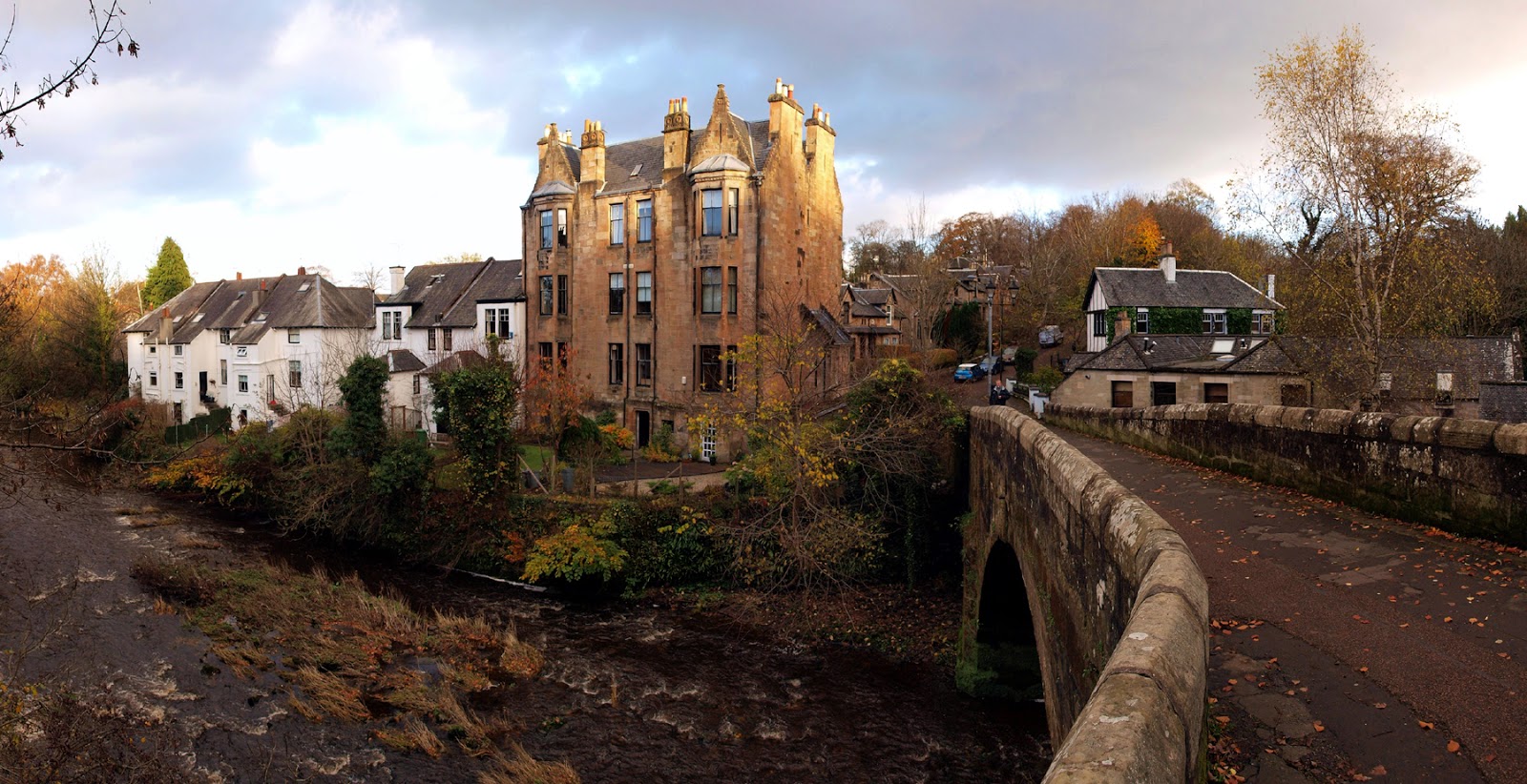
Recently we've had some unusual weather. It has been cold
but dry and sunny as opposed to the normal cold but wet and dull. It's too cold
to go far but there are things of interest nearby. This is a random run through
the city generally along the River Clyde.
At the Science Centre I found the paddle streamer Waverley
at its winter moorings. The ship was built in 1946 and is the last passenger
carrying paddle steamer in the world. The Waverley provides day trips throughout
the country during the season and is claimed to be the "most photographed
ship in the world".
A Clydeside montage - L to R the Armadillo (auditorium), the
Hydro (indoor arena) and the Finnieston crane.
Fair warning - there will be bridges. This is the railway
bridge crossing the Clyde into Central Station. Ok, trains are heavy, but this
bridge seems like overkill even by Victorian standards.
The Briggait was, for a century, Glasgow's fish
market - now an arts centre.
I've always liked the winged sea horses
The place looks a bit rough. I found this
photograph of the building when it was painted. I'm not sure blasting it back
to stone was a good idea.
Cambuslang Bridge. This is a strange one. I worked for the
Roads Department but never heard of this bridge. It was built in 1892 but at
some point was found to be under strength. Weight restrictions were applied and
eventually new bridges were built that replaced it. The bridge remained for pedestrians, In 1977 the council built another footbridge beside it presumably
because demolition was planned. But it's still here with two adjacent bridges
carrying out the same function. The bridge is obviously not being maintained
but isn't in bad condition. Left alone it'll eventually rust away and fall into
the Clyde. Maybe in 100 years or so.
Rosebank Dye Works. The east end of the city has many derelict industrial buildings
but this is special. A fine structure with nice Greek key pattern in
contrasting brickwork. It was constructed in 1881 for yarn dying. As far as I can
find out it has been empty since 1945 (can that be true?). Cambuslang isn't
the most desirable area of the city but surely something could be done with
this place.
Cuningar Bridge. This new bridge gives access to a redeveloped
area of land. It might look rusty - and it sort of is. This is weathering
steel - steel with a small percentage of chromium added. This causes it
to form a stable oxide layer that does not require painting. In time this
should weather to a dark brown finish. The area was variously reservoirs for
the city's water supply, quarries and a landfill site. It has been developed
into a parkland. This is a good example of the development of the east end of
the city - previously a fairly run down post industrial area.
Reel of Three. This is a sculpture on a roundabout on a
recent development in Dalmarnock. It's across the road from my site offices
(see below) When I was here this was a derelict factory (Phoenix tube works, I
think) It depicts people engaged in a frantic dance.
Dalmarnock
Bridge. I spent a year working on this bridge in 1996. The job was to replace
the existing steel deck with a new one. Not too difficult but the existing
ironwork - everything red in the photograph - had to be removed, refurbished,
replaced if necessary and re-erected. Not any easy job, but hey, that's what I was getting paid for.
An outstanding issue from my accident back in May is the SV's tank. The bars bent back and dented the tank. I wasn't too bothered about it but, because there was some bare steel, I had to do something before it rusted.
A possible "cheap and nasty" repair would be to fill the dent and find a nice sticker for the tank. Another option I thought about was a complete re-spray. I've never really liked the colour of the bike and, since it's a single colour with no coach lines this would make things easier. I'm not going to do this at present but might in the future.
The damage
I
got this set of stickers from eBay. These are associated with the late
racer Barry Sheene. I put his No. 7 stickers on the tank and continued
the theme with Donald Duck on the back of my helmet.
The stickers were tricky to apply. They don't
fit smoothly onto a surface that curves in two directions. I had to put some
cuts in the stickers to get a fit.
The SV is currently laid up for the winter. When
I post about my adventures next year you'll know why the SV has the tank
stickers.
During my run along the White Cart I was reminded of events
from my past. In 1992 I was working on a construction site building the M77
motorway at the point where it crosses the river.
Here I met Colin MacLeod. You could say we were on opposing sides. He was an anti-roads protestor. For the year it took to complete this section of the road he camped out in the woods engaged in a (mostly) one man protest. He came to prominence when he took to the trees and lived up there for nine days. He was dubbed "The Birdman of Pollok" by the press.
In June he upped the ante. We arrived for work on Monday
morning to find Colin perched on top of the 150 foot jib of a crawler crane.
The police were called and the crane operator told the cops "I'll lower
the jib so you can arrest him". The cops replied that if he fell off and
was injured they'd arrest the operator.
So we waited…..for 6 days. Then Colin came down, was
promptly arrested then bailed out by his supporters. The road was completed
without much further interruption. I had to admire his dedication to his cause.
He died at a young age in 2005.
Anchor Mills. Paisley was known for textiles and this
mill was part of world's largest thread producing factory. Now apartments and offices
Paisley Abbey. Established in 1163, but mostly 15th
century (I think)
I came across this mural on the gable end of a
tenement near the river. It depicts a kingfisher and is dedicated to Alexander
Wilson. He was a weaver who emigrated to America in 1794 and became known as
the "Father of American Ornathology"
On the banks of the river is Paisley Town
Hall. Typical of the grand public buildings constructed in the Victorian era.
Lift Bridge, Renfrew. Just before the White Cart joins
the River Clyde is this lift bridge. It was built in 1924 and is still in
operation.
And for the climax of my tour of the White Cart - something
really special…..two boulders behind a fence. No, wait, bear with me.
The stone on the left is the Argyll Stone. In 1685 Archibald Campbell, 9th Earl of Argyll led a revolt against King James VI. This failed and he was captured near this
spot and subsequently executed. This stone was (possibly) the pediment of a
cross near where he was captured.
On the right is a stone known as "St Coval's
Chariot". St Conval was a 6th century Irish priest who was carried across
the sea to Renfrew on this boulder - like a divinely-powered surfboard, I
suppose. He then worked to convert the Picts to Christianity. The stone was
(and maybe still is) a place of pilgrimage. The stone has a depression on top
(where the leaves are) and pilgrims would drink the rainwater in it to cure their ills. I would
have tried this myself but the fence prevented me.
On a very wet and dull day I'm in Clydebank looking across
the River Clyde to where the Cart joins it.
I hope you enjoyed my run across the grey old city. As
always I was aware of how much is packed into a small distance in this country
and that even though it's cool, wet & dull a run on the bike can be
enjoyable.
I didn't want to end the tour on a bum note so today I went back to Clydebank when it was sunny.
It's an idea of mine to follow the course of a river and see
that I can find. I've posted a few such runs. But it's cold, dull and wet so
I'm reluctant to go too far. The White Cart is a short river that rises in the
hills near me and wanders across the south side of Glasgow for about 20
miles before joining the River Clyde. There can't be much of interest in that.
Can there? Well let's see.
This is near my house and I've featured it before (where I
incorrectly said it's on the Cart) It's an old mill outside Eaglesham. It's on
Polnoon Water, a tributary of the White Cart.
This was built as a cotton spinning mill in the late 18th
century. The stream has been dammed to provide power for the mill. It was
nicely converted into apartments and I found an old photograph from 1965 before
conversion. The website says that the photo can't be put on-line but I suppose
a link is ok.
The ford at Eaglesham. I often pass this on my travels.
The depth gauges are a recent addition - it seems that the metric system has
not yet been adopted in East Renfrewshire.
The footbridge in Linn Park. Only a few miles from my
home and I'd never been here. As someone who toiled in the bridge building
industry this is a little gem. It's an early example of a cast iron bridge
dating from the early 1800s. Cast iron was replaced by wrought iron then steel
but because it's cast rather than rolled it means that complex shapes are
possible. Also cast iron is less affected by corrosion than steel so this
bridge, built at the time of the Battle of Waterloo, is still in good condition
and with a little maintenance it should effectively last forever.
Snuff Mill. Again, close to where I live but I can't remember being
here. The (former) mill is on the left behind the bridge and milled snuff (amoungst other
things)
Sitting in a fine location on the bank of the river is
Pollok House. Once a private house and estate it is now public.
Footbridge at Ross Hall Academy. In the distant past I
earned a crust designing and detailing reinforced concrete so I appreciate the single, elegant form of this bridge.
Autumn scenery at Crookston Road
Crookston Castle. Again I've passed this many times but
never been bothered to visit it. It's in good condition for something built
around 1400. It's in a pleasant woodland setting in well maintained grounds.
Part of the castle is missing but, given its history, it's lucky that there's anything here at all. In 1489 the Earl of Lennox revolted against the new king James IV. The
king laid siege to the castle and used a formidable weapon to end the
rebellion. Mons Meg was a huge siege cannon that fired a 20" diameter, 385
pound stone cannon balls. After a few of these hit the castle the defenders gave
up.
Honda recently announced that they had built 100 million
Super Cubs since production started in 1958 making it the most numerous powered
vehicle ever.
The bike was known as the Honda 50 or C50 in the UK (to avoid
confusion with the Triumph Tiger Cub) and the Passport in the USA (Piper
aircraft used the name Super Cub)
Early '70's C50
The story of the Cub started in 1956 when Honda's founders
Soichiro Honda and Takeo Fujisawa visited Germany and noticed the popularity of
small motorcycles and scooters. They came up with the idea of a "universal
motorcycle" that would appeal to a wide range of buyers in the West and
the developing world. They rejected the scooter concept because the small
wheels could not cope with poor roads in developing areas and because the
enclosed engine made maintenance difficult.
The bike is no longer in Honda's range in the West having
been superseded by scooters but its popularity not only continues but is
increasing. It is currently produced in 15 countries from Viet Nan to Peru. The
first 50 million units took from 1958 until 2005 to produce but that figure has
now doubled.
The Cub was marketed in the US using this famous campaign.
Honda was trying to attract customers who weren't motorcyclists.
In the developing world the Cub is used for load carrying
The bike is a "step thru" with a pressed steel chassis and central spine. The engine is suspended below the spine. The motor is a four stroke of 50-110cc. Small bikes had been two strokes but the
four stroke gave the C50 durability and economy. The bike had a conventional
three, later four speed gearbox but an automatic centrifugal clutch. Fujisawa
saw the bike being used to deliver bowls of noodles and that the rider could
hold a tray and ride at the same time!
The NSU Quickly had many of the features of the Cub and is
likely to have inspired its design
A new version of the Cub was recently shown. Why change a winning formula? It seems that this bike is to be sold in the UK.
In 2015 Kawasaki introduced the Ninja H2. This is a
supersport bike powered by a supercharged 1000cc 4 cylinder engine. Initially
there were two versions. A street bike with 200 bhp and the track-only H2R with
an insane 310 bhp. These bikes are expensive - the H2 is twice the price of the
ZZR1400 (ZX14) or ZX10 and the H2R is a lot more.
The H2 doesn't seem the obvious basis for a touring machine but
Kawasaki have announced the H2 SX. This is a sports touring version with a more relaxed
riding position and panniers. So if you have deep pockets (probably about
£30,000 - no price yet) and like to tour very fast - this might be for you.
Promo video - nice alpine scenery
Slick "studio" video
Kawasaki have used the H2 name previously - the Mach IV
750cc two stroke triple of 1972-5.
***UPDATE***
The H2 SX seems to be priced at £15,000 - so a lot less than
I expected given that the H2 it's based on is £28,000.