Wednesday, 22 November 2017

White Cart Run - Part #1


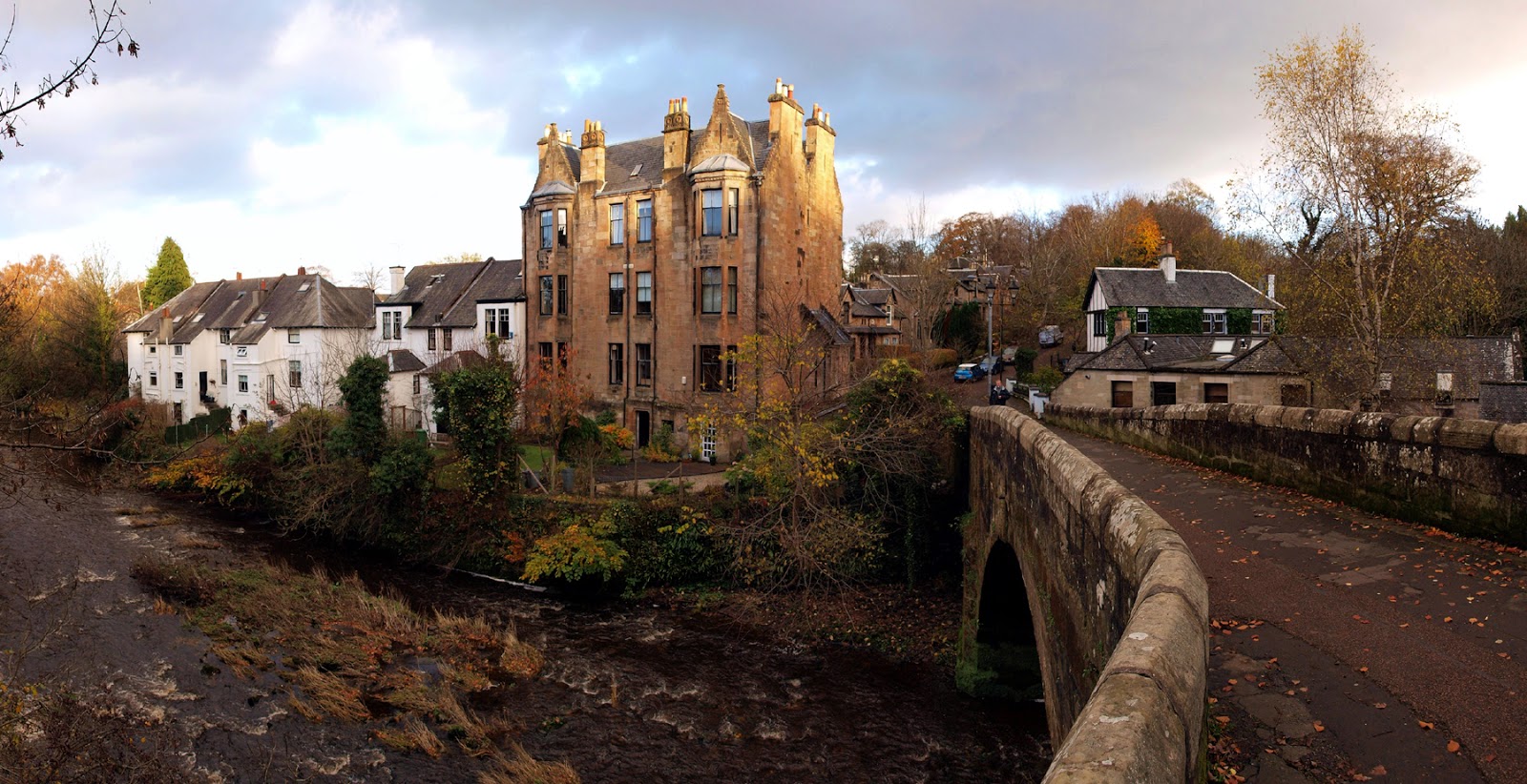
It's an idea of mine to follow the course of a river and see that I can find. I've posted a few such runs. But it's cold, dull and wet so I'm reluctant to go too far. The White Cart is a short river that rises in the hills near me and wanders across the south side of Glasgow for about 20 miles before joining the River Clyde. There can't be much of interest in that. Can there? Well let's see.

This is near my house and I've featured it before (where I incorrectly said it's on the Cart) It's an old mill outside Eaglesham. It's on Polnoon Water, a tributary of the White Cart.

This was built as a cotton spinning mill in the late 18th century. The stream has been dammed to provide power for the mill. It was nicely converted into apartments and I found an old photograph from 1965 before conversion. The website says that the photo can't be put on-line but I suppose a link is ok.


The ford at Eaglesham. I often pass this on my travels. The depth gauges are a recent addition - it seems that the metric system has not yet been adopted in East Renfrewshire.

The footbridge in Linn Park. Only a few miles from my home and I'd never been here. As someone who toiled in the bridge building industry this is a little gem. It's an early example of a cast iron bridge dating from the early 1800s. Cast iron was replaced by wrought iron then steel but because it's cast rather than rolled it means that complex shapes are possible. Also cast iron is less affected by corrosion than steel so this bridge, built at the time of the Battle of Waterloo, is still in good condition and with a little maintenance it should effectively last forever. 


Snuff Mill. Again, close to where I live but I can't remember being here. The (former) mill is on the left behind the bridge and milled snuff (amoungst other things)
Sitting in a fine location on the bank of the river is Pollok House. Once a private house and estate it is now public.
Footbridge at Ross Hall Academy. In the distant past I earned a crust designing and detailing reinforced concrete so I appreciate the single, elegant form of this bridge.
Autumn scenery at Crookston Road


Crookston Castle. Again I've passed this many times but never been bothered to visit it. It's in good condition for something built around 1400. It's in a pleasant woodland setting in well maintained grounds. Part of the castle is missing but, given its history, it's lucky that there's anything here at all. In 1489 the Earl of Lennox revolted against the new king James IV. The king laid siege to the castle and used a formidable weapon to end the rebellion. Mons Meg was a huge siege cannon that fired a 20" diameter, 385 pound stone cannon balls. After a few of these hit the castle the defenders gave up. 


Tuesday, 14 November 2017

Honda Super Cub - 100,000,000 and Counting

Honda recently announced that they had built 100 million Super Cubs since production started in 1958 making it the most numerous powered vehicle ever.

The bike was known as the Honda 50 or C50 in the UK (to avoid confusion with the Triumph Tiger Cub) and the Passport in the USA (Piper aircraft used the name Super Cub)

Early '70's C50
The story of the Cub started in 1956 when Honda's founders Soichiro Honda and Takeo Fujisawa visited Germany and noticed the popularity of small motorcycles and scooters. They came up with the idea of a "universal motorcycle" that would appeal to a wide range of buyers in the West and the developing world. They rejected the scooter concept because the small wheels could not cope with poor roads in developing areas and because the enclosed engine made maintenance difficult.

The bike is no longer in Honda's range in the West having been superseded by scooters but its popularity not only continues but is increasing. It is currently produced in 15 countries from Viet Nan to Peru. The first 50 million units took from 1958 until 2005 to produce but that figure has now doubled.

The Cub was marketed in the US using this famous campaign. Honda was trying to attract customers who weren't motorcyclists.

In the developing world the Cub is used for load carrying
The bike is a "step thru" with a pressed steel chassis and central spine. The engine is suspended below the spine. The motor is a four stroke of 50-110cc. Small bikes had been two strokes but the four stroke gave the C50 durability and economy. The bike had a conventional three, later four speed gearbox but an automatic centrifugal clutch. Fujisawa saw the bike being used to deliver bowls of noodles and that the rider could hold a tray and ride at the same time!

The NSU Quickly had many of the features of the Cub and is likely to have inspired its design
 
A new version of the Cub was recently shown. Why change a winning formula? It seems that this bike is to be sold in the UK.

Saturday, 11 November 2017

Featured Bike - Kawasaki H2 SX (2018)


In 2015 Kawasaki introduced the Ninja H2. This is a supersport bike powered by a supercharged 1000cc 4 cylinder engine. Initially there were two versions. A street bike with 200 bhp and the track-only H2R with an insane 310 bhp. These bikes are expensive - the H2 is twice the price of the ZZR1400 (ZX14) or ZX10 and the H2R is a lot more.

The H2 doesn't seem the obvious basis for a touring machine but Kawasaki have announced the H2 SX. This is a sports touring version with a more relaxed riding position and panniers. So if you have deep pockets (probably about £30,000 - no price yet) and like to tour very fast - this might be for you.


 Promo video - nice alpine scenery


Slick "studio" video


Kawasaki have used the H2 name previously - the Mach IV 750cc two stroke triple of 1972-5.   

 
***UPDATE***

The H2 SX seems to be priced at £15,000 - so a lot less than I expected given that the H2 it's based on is £28,000.


Tuesday, 7 November 2017

Loch Lomond


Loch Lomond is Scotland's largest loch - ok, it's only 24 miles long by 5 miles wide at its maximum. Tiny by international standards, but hey, it's ours.

It's also probably the most visited due to its proximity to Glasgow. But today it was quiet with most of the tourists long gone. It made a good location of a short run.


The Maid of the Loch at Balloch. This paddle steamer operated on the loch from 1953-81 and has been under refurbishment here for the last 20 years.

The loch from Balloch

The CBF at Balmaha


Rowardennan

War memorial at Rowardennan


A couple of moody monochromes


Thursday, 2 November 2017

Autumn Run


A strange thing happened today - the sun shone. So I had to get out for a run. I thought it would be cold so I took the CBF rather than the SV. In doing this I lost 50 bhp but gained a pair of heated grips. As it turned out it was pleasantly mild in the sun but the grips saved the day as it became evening.

Abandoned church in Barrhill. I think I've featured this building previously but I do like a picturesque ruin.

Old crawler tractor

I liked this old lattice truss footbridge over the Cross Water of Luce with its rust shining in the autumn sun.

It was very calm today. Nice riding conditions but not so good for this wind farm.

The Cross Water of Luce

New Luce

Now this confused me. It is a strangely shaped bucket on a pole suspended by a chain. What was its purpose? Well, nothing really, it's an art installation.

The sun over Luce Bay

Luce Bay

Tuesday, 31 October 2017

CBF Starter Motor Fix


On a recent visit to the city centre my Honda CBF250 failed to start. The instrument lights came on but the starter remained silent. I enlisted the help of a passer-by to give me a push. The CBF bumped started easily so I got home ok. Back home the starter would work occasionally. There was power getting to the motor so I had a good idea what was wrong.

The first thing to check on a DC motor is the brushes. These are made of carbon and wear down with time. One of the two brushes was well below the service limit so replacement was necessary.

After market brushes are available but I didn't fancy trying to connected them up. The starter draws a lot of current and I'm not sure my soldering would have took it. I bought an original Honda set that come with the brushes connected to the plate and terminal.


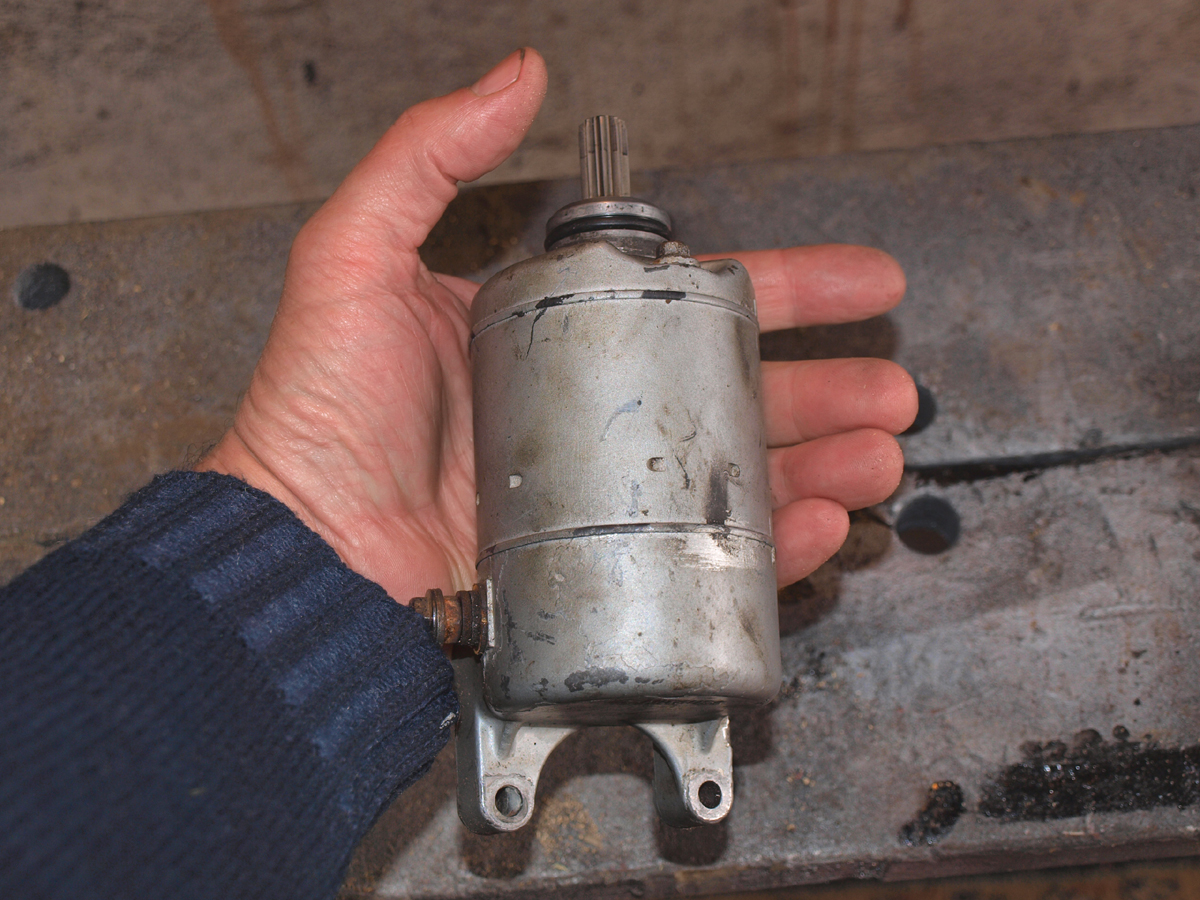
The little starter motor. This might be small but a replacement unit is £588.18 ($777) - much more than my whole bike is worth!

The parts. I got them from Fowler's. I ordered on Sunday evening and they arrived this morning (Tues), so good service.

The old and the new - note the length of the brushes.

All back together and the little bike's starter is spinning like a top! Given the weather maybe I should just use the car.

Monday, 30 October 2017

An Autumn Scene (and a Quirky Story)


At this time of year I usually present you with some photographs of autumn foliage. I haven't got many this year. To capture the colours of the leaves you need some sunshine and this has been in short supply recently. I took this snap in the Clyde Valley recently but wasn't going to post it until I read the story of the location.


The photograph is across Milton-Lockhart Bridge. This is a private road and the gatehouse at the far end of the bridge suggests that this is the entrance to a stately home. And so it was, "was" being the operative word.
There is a photograph of the bridge crossing the River Clyde I took some time ago. It is a sturdy and well-proportioned masonry arch.

Beyond it once stood Milton-Lockhart House, built in 1839. This is where the story gets strange. In 1987 Japanese actor/director, Masahiko Tsugawa happened to be passing the house, by this time derelict. He arranged to buy the property and have it transported to and re-erected in Japan. Its journey east was partly by the Trans Siberian railway, permission being granted by President Mikhail Gorbachev. 


The house, as it was.
Masahiko looks happy with his purchase
The house, now renamed Lockheart Castle, at its new location in Japan.
The house is now the centre of a medieval village and home to the World Santa museum.


http://www.jrs-w.com/lock-heart/english/index.html